Contract grinding
As experts in contract grinding, we know: Most materials are easy to grind and can be crushed by mechanical stress such as pressure, shearing, cutting or friction at room temperature.
However, there are also materials for which purely mechanical stress is not sufficient for shredding. This is the case, for example, with polymers (plastics such as PP, PET, PA, etc.), but also with other materials that only deform under mechanical stress instead of breaking. In turn, these materials melt when exposed to heat.
Cold grinding or cryogenic grinding is used to achieve the desired result during grinding.

Cryogenic grinding
In cryogenic grinding, temperature-sensitive and lubricating products, including polymers, but also resins, foodstuffs, seeds and fine chemicals, are ground in our Cryogenic Mill.
The advantage of this type of grinding is that it prevents thermal damage and corresponding grinding losses!
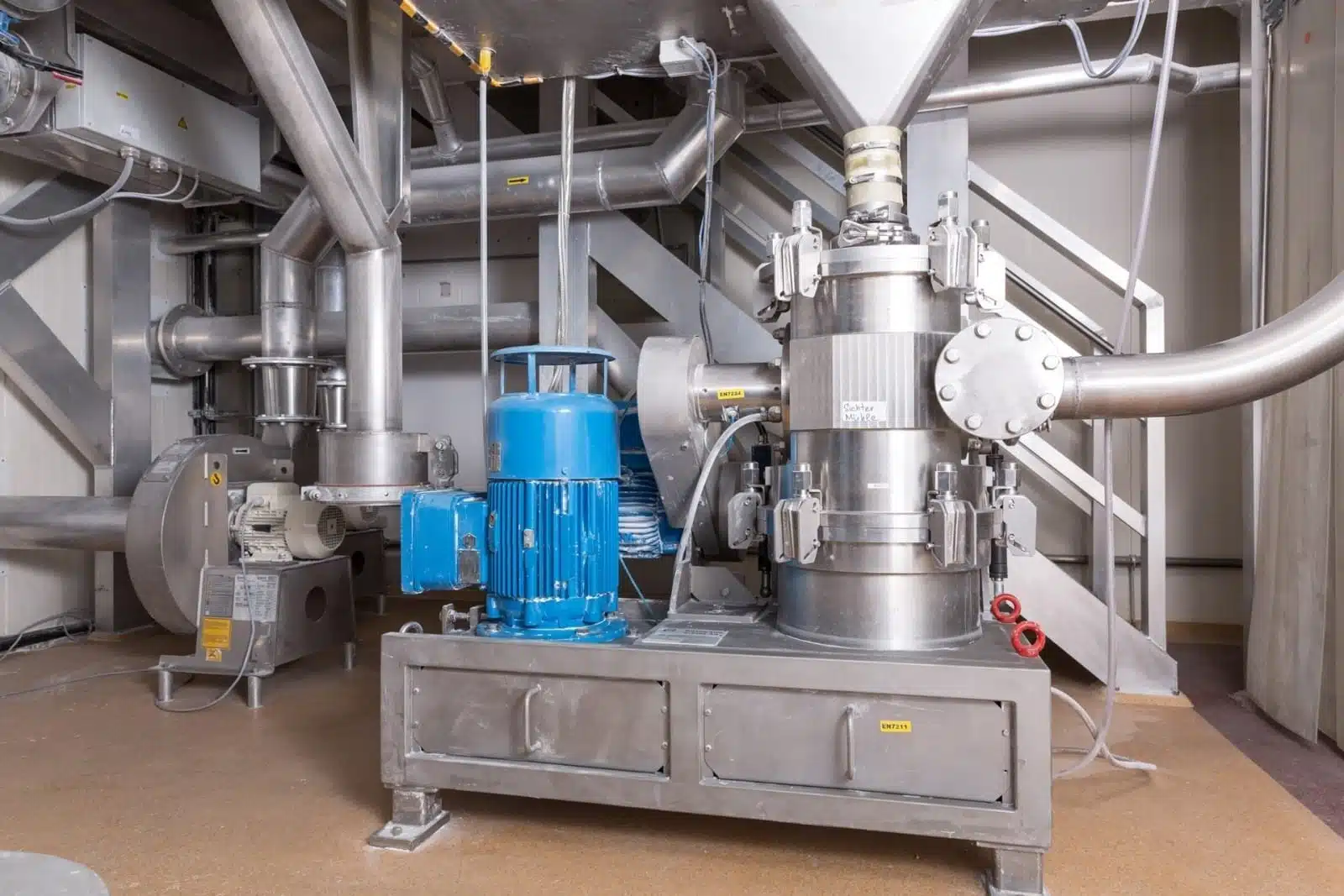
In use: innovative grinding systems with vortex screw coolers and liquid nitrogen cooling
The fracture behavior of elastic plastics can be completely changed by using liquid nitrogen. The cooling process causes the glass transition temperature to fall below the temperature. This reduces the material’s ability to withstand high mechanical stresses due to its elastic properties. The result is cold embrittlement of the material – it breaks like glass.
The shape, surface and size of the particles can be influenced using the grinding tool and the appropriate temperature.
Advantages of the process:
The addition of liquid nitrogen also contributes to fire and explosion protection, germ protection and the preservation of active ingredients.
Ideally equipped for every application.
Cryogenic ultrafine grinding for target finenesses
Versatile ultrafine grinding for plastics, food and fine chemicals
Our ultrafine grinding covers a wide range of products – from polymers and resins, foodstuffs and seeds to fine chemicals such as vitamins and surfactants. Thanks to state-of-the-art grinding technology, we achieve precise particle size distributions that are optimally matched to the respective material properties and applications. In this way, we guarantee the highest quality and reproducibility in every batch.
Cryogenic grinding is useful when temperature-sensitive, elastic, or lubricating products do not break down properly at room temperature. These include plastics such as PP, PET, or PA; resins; food products; seeds; and fine chemicals, which are cooled with liquid nitrogen and become easier to grind.
Cold grinding alters the fracture behavior of elastic materials through intense cooling. The product becomes more brittle, can be ground more precisely, and is protected from thermal damage, clumping in the mill, and unnecessary grinding losses.
The Cryogenic Mill is designed for target finenesses ranging from 10 to 2,000 µm. This makes it suitable for cryogenic ultrafine grinding of plastics, resins, food products, seeds, and fine chemicals with defined particle size distributions.
Products can be delivered in bags, big bags, octabins, or drums. They are fed through feeding stations, dosing screws, and swirl screw coolers; the ground material can then be filled into bags, drums, big bags, cardboard boxes, or custom containers.
Liquid nitrogen cools the material below the glass transition temperature, thereby enabling controlled cold embrittlement. In addition, the cooling process can help prevent fires and explosions, inhibit microbial growth, and preserve sensitive active ingredients.
You are currently seeing a placeholder content of Accessibility Widget. To access the actual content, click on the button below. Please note that data will be passed on to third-party providers.
More informationYou are currently viewing a placeholder content from YouTube. To access the actual content, click the button below. Please note that doing so will share data with third-party providers.
More InformationYou are currently viewing a placeholder content from Google Maps. To access the actual content, click the button below. Please note that doing so will share data with third-party providers.
More Information